
Roll over image to zoom in
Against Method: Outline of an Anarchistic Theory of Knowledge

Against Method: Outline of an Anarc..., Feyerabend, Pau
£14.99
in stock
Against Method: Outline of an Anarchistic Theory of Knowledge

£19.67
in stock
Against Method: Outline of an Anarchistic Theory of Knowledge
£22.37
in stock
Against Method: Outline of an Anarchistic Theory of Knowledge
£20.36
out of stock
Against Method: Outline of an Anarchistic Theory of Knowledge, Fe

£82.49
out of stock
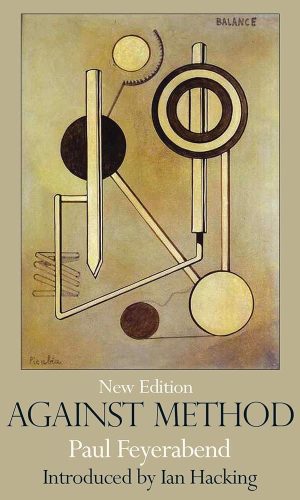
Paul Feyerabend’s globally acclaimed work, which sparked and continues to stimulate fierce debate, examines the deficiencies of many widespread ideas about scientific progress and the nature of knowledge. Feyerabend argues that scientific advances can only be understood in a historical context. He looks at the way the philosophy of science has consistently overemphasized practice over method, and considers the possibility that anarchism could replace rationalism in the theory of knowledge.
This updated edition of the classic text includes a new introduction by Ian Hacking, one of the most important contemporary philosophers of science. Hacking reflects on both Feyerabend’s life and personality as well as the broader significance of the book for current discussions.
Read more
by carlo sansolo
Classical book that intends expose the rigid methodology of the science, explaining and exposing that during a long time the narrative of science was not through the Karl Popper manner. Explaining that not everything in science was through the falsification method.
by Richard H. Pierce
A great book – probably more timely and necessary and insightful in 2016 than when written. Feyerabend was and is obviously a “feather-rustler” of the scientific establishment – for which I am grateful to him. I have spent a lot of years being suspicious of the pious, arrogant, self-serving, omnipotent attitude of some/much of science and scientists. I have become painfully aware of how many grand proclamations and expectationshave been foiled onto humanity, especially the under-privileged, under-developed, and unwitting – only to have history show them way short of the mark and actually doing great harm to lesser populations and our Planet.
For the 1st time for me, Feyerabend lays bare the follies of the scientific method, the damage it does, and the new, creative ideas it attempts to squash in the name of method – really, though, in the name of power, control, and arrogant hierarchies. I’ve felt that most new, good, ground-breaking science has come in spite of the method – from outliers, amateurs, radicals and radical approaches. He is right on – very focusing for me. And, with science in need of a new view of science, of people, of the planet, and a new approach – his is a refreshing and necessary effort if we are to move ahead into the real world of diversity, equality, and quality, esp. with Natuarla Systems, complex situations, and chaos – which is where the big problems facing us lie.
Bravo for brave new ideas against an establishment long over-due for a “reset” and which would allow brave new proposals leading to world-changing and world-view changing results.
Bravo
Dick Pierce
by Josue Ayuso
Anything goes…
But first, read the text.
by Wesley Corbett
I read this book ‘to know my enemy’ mainly to destroy the arguments used by my old postmodernist college teacher. As you may have figured out I originally stood in complete opposition to this book, rallying behind the likes of Alan Sokal and Richard Dawkins.
However, after reading Thomas S. Kuhn’s: “The structure of scientific revolutions” on paradigm theory (read this first), I felt I had to study Feyerabend’s take. After doing this, I can at least concede that I have taken on board some of his relativist criticisms albeit I have done so with a large pinch/grain of salt. I am still by no means a postmodernist and as usual I stay close by to my copy of “beyond the hoax”.
A quick word of warning about most pre-postmodernist “dada” or any postmodernist literature, it can be very wordy at times, so to those very lost lay-men out there…watch out! I think that with a good head on your shoulders you should be able manage it while it coincides with your A levels.
Also be very careful when reading this book, always approach it with a skeptical mind because it is very tempting to fall for ‘woo’ when it is written so well. If you feel you are falling for empty rhetoric return to your Sokal immediately.
Five stars for the sheer cheek of Feyerabend!
by The Prussian Reader
This book should not be reduced to one of its statements, “anything goes”, because Feyerabend’s argument is much more complex than that. Feyerabend tells us in a convincing way that the progress of science is made possible by people who do NOT act according to established rules and by people who put ostensibly obvious truths into question. Feyerabend was a very educated man, and his book should be read by every scientist, but also by the public at large – at last as long as we are free to think on our own.
by P. Alves De Feijo
Amazing book. Good introduction to criticism on science.
by Cliente Amazon
True masterpiece
by GEORGES-PICHOT Jean-Pierre
très bien
by Mark Lisac
Compelling argument and unfailingly interesting writing. Great companion piece to Kuhn’s Structure of Scientific Revolutions, although in this one you get a much stronger sense of the author’s mind and personality
by Danielle H
A bit heavy to read on the philosophy side, need some familiarity with Popper, Kant, Lenin, Marx, Hegel, Kierkigaard – get my drift, but apart from that, its pretty comprehensive review of the power and lack of power science has to explain things much less itself